
Assessing Personal Tension in Your Team
Compare three evidence-based ways to understand personal tension in your team: identifying relationship conflict, tracing conflict origins, and using a
The question
How bad is the personal tension in my team?

Overview
Personal tension in your team is shaped by how task disagreements can turn into interpersonal clashes, creating friction unrelated to the work itself. Research describes this as relationship conflict, and it can reduce team satisfaction and enthusiasm. There is no one-size-fits-all way to assess it, but three distinct practices from the evidence can help you understand what is happening in your team.
Below are three approaches grounded in team conflict research. Each offers a different lens for examining tension, and none is proven to be the best for every team. The practices are: identifying relationship conflict through specific signs, tracing whether a single individual is driving the tension, and using a team discussion to reach a shared assessment.
Identify Relationship Conflict by Observable Signs

This practice involves looking for clear signals of relationship conflict in your team, such as personality clashes, visible tension, anger, or jealousy among members. You can watch for moments when disagreements about work turn into personal accusations or when people seem annoyed with each other for reasons unrelated to the task. It is a low-effort way to start noticing what is already happening without needing anyone else's help.
Studies describe relationship conflict as personal incompatibility that includes tension, animosity, and friction not related to the task. Researchers measure it with items about personality clashes, tension, anger, and rivalry. One study found that such conflict is linked to lower desire to stay on the team and lower satisfaction. This practice helps you recognize the signs, but remember that simply noticing tension does not tell you its cause or how to resolve it.
Trace Tension to a Potential 'Bad Apple'
This practice involves looking for whether one person might be repeatedly sparking tension with others. You can observe if a single team member regularly disregards relationships, shows little concern for tasks, or reacts poorly to stress. It requires paying attention to patterns over time and may involve asking yourself whether one person’s behavior is creating turmoil that spreads through the team.
Research describes 'bad apples' as individuals whose low agreeableness, lack of conscientiousness, and emotional instability lead to relationship conflict. In case studies, sometimes the same person acts as both the instigator and a principled dissenter, affecting the whole team. However, not all conflict originates from one person; in some teams it spreads through different members. This practice can help you see if a single origin is plausible, but it does not confirm intent or give a complete
Use a Consensus Team Discussion to Assess Tension
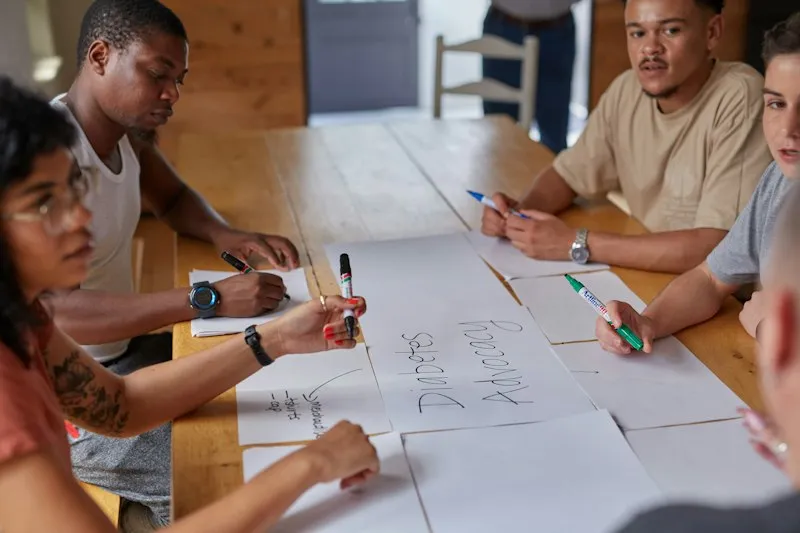
This practice involves gathering your team to discuss questions like 'How frequently was there friction among members?' and agreeing on a single answer as a group. It requires everyone to share their perspective and work toward a shared perception of the team’s tension. This approach takes more time and requires willingness from all members to participate honestly.
Researchers recommend a consensus method for measuring team-level relationship conflict, where the team discusses items about friction, personality clashes, and anger and agrees on one response. This captures a team-level view rather than individual opinions. A limit is that it assumes a team can reach honest agreement, which may be difficult if tension is high or if members feel unsafe speaking openly. It is best used when you have enough trust for an open conversation.
Take it further
Observing Tension
Which of these approaches feels most realistic for you to try first, given your current team dynamics?
Talk it out
Starting a Conversation
Would you be open to talking about what kinds of tension you notice in your team, without needing to solve anything right now?
References
Sources & evidence
4 research papers informed this article. The numbers beside each section link here, and each DOI opens the original paper.
Source 1:The influence of intra‐team conflict on work teams' affective climate: A longitudinal study
Gamero, Nuria, González‐Romá, Vicente, Peiró, José M. (2008). The influence of intra‐team conflict on work teams' affective climate: A longitudinal study. DOI 10.1348/096317907x180441
DOI 10.1348/096317907x180441articleSource 2:Emotion regulation as a boundary condition of the relationship between team conflict and performance: A multi‐level examination
Jiang, Jane Yan, Zhang, Xiao, Tjosvold, Dean (2012). Emotion regulation as a boundary condition of the relationship between team conflict and performance: A multi‐level examination. DOI 10.1002/job.1834
DOI 10.1002/job.1834articleSource 3:Things Are Not Always What They Seem: The Origins and Evolution of Intragroup Conflict
Shah, Priti Pradhan, Peterson, Randall S., Jones, Stephen L., Ferguson, Amanda J. (2020). Things Are Not Always What They Seem: The Origins and Evolution of Intragroup Conflict. DOI 10.1177/0001839220965186
DOI 10.1177/0001839220965186articleSource 4:Team deep-level diversity, relationship conflict, and team members' affective reactions: A cross-level investigation
Tekleab, Amanuel G., Quigley, Narda R. (2014). Team deep-level diversity, relationship conflict, and team members' affective reactions: A cross-level investigation. DOI 10.1016/j.jbusres.2012.12.022
Next read
Keep reading
 MomentsIs this conflict serious or just a minor disagreement?Assess conflict severity by considering the dyad's centrality, location, and specific interactions. Use observation and targeted questions to gauge impact.3 min read
 DecisionHow Do I Know If Our Team Conflict Is Harmful or Just a Healthy Debate?Assess team conflict by focusing on specific pairs rather than the whole team. Learn three strategies to tell harmful conflict from healthy debate, based on4 min read
 ExplainerDecoupling Task and Relationship ConflictLearn how teams can separate task disagreements from personal friction, the role of emotional regulation, and the impact on performance.6 min read
 How-toWhy do we keep arguing about the wrong things in our team?Understand common patterns that shift team arguments from tasks to personal issues, and learn strategies to refocus conflict on what matters.6 min read
 DecisionWhy Do I Keep Having Personal Clashes With Teammates That Ruin Our Work?Personal clashes with teammates can erode collaboration. Learn three strategies to address relationship conflict based on your current capacity and the3 min read
 ExplainerTask InterdependenceTask interdependence describes how much team members rely on each other to complete their work. Learn what it is, how it affects teams, and how to manage it.5 min read