
How Do I Know If Our Team Conflict Is Harmful or Just a Healthy Debate?
Assess team conflict by focusing on specific pairs rather than the whole team. Learn three strategies to tell harmful conflict from healthy debate, based on
The question underneath
How do I know if our team conflict is harmful or just a healthy debate?
Sound familiar?
You are in a meeting when two teammates start arguing, and you cannot tell if this is productive debate or a sign of deeper trouble.
First, get oriented
Before you choose
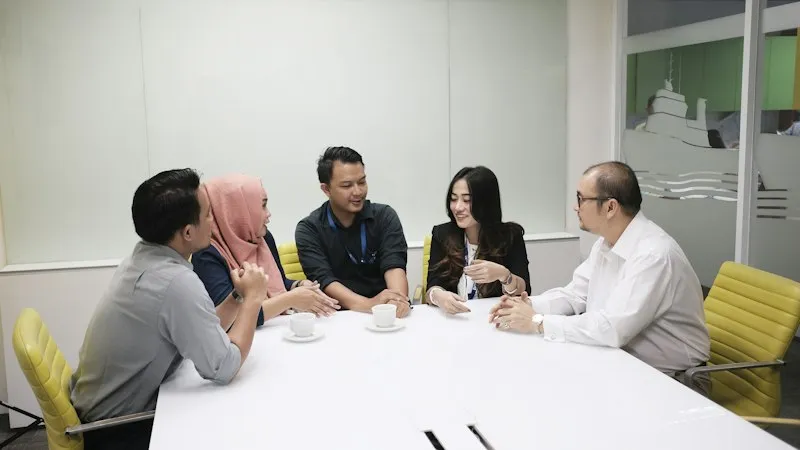
You are facing a moment when a disagreement between teammates feels tense, but you are not sure if it is a normal part of working through ideas or something that could harm the team. This uncertainty is common, and it is okay to feel stuck. There is no single right answer for how to respond, but there are trade-offs to consider based on your current capacity and the specific situation.
The key is to look at the conflict between specific pairs of people rather than the whole team mood. Research suggests that dyadic conflict, or conflict between two individuals, is the most common type of conflict in teams, and it can have different effects depending on whether it is about the task or about personal relationships. Understanding these differences can help you decide whether to step in, observe, or let the debate continue. This decision is not about finding a perfect solution but about choosing the approach that fits your team's needs and your own resources right now.
Find your starting point
What feels closest to your situation right now?
Choose the situation closest to yours. We’ll take you to that path so you can weigh it without committing to anything.
- See this pathPathI am still unsure if it is task or relationship conflict.
- See this pathPathI am wondering how much this conflict affects the whole team.
- See this pathPathI feel the conflict is blocking progress and needs intervention.
Still unsure? Ask yourself:
What trade-offs are you weighing as you consider these strategies?
Compare your paths
Three ways forward, different trade-offs
There is no perfect choice. Skim the trade-offs, then read the path that fits what you can manage today.
Path
Strategy 1: Observe and Assess the Conflict Type
This strategy involves stepping back to observe the conflict and identify whether it is task-related or relationship-related. You would listen to the conversation and note if the discussion is about the pros and cons of different ideas, as in task conflict, or if you hear personal digs, disrespect, or feelings of being pulled apart, which are signs of relationship conflict [sourceRef: 1]. This requires no immediate action, only your attention, so it is low effort.
Research suggests that task conflict can be productive because it involves debating evidence and alternatives, while relationship conflict is often harmful [sourceRef: 1]. However, this assessment is not always clear-cut, and conflicts can be mixed. The trade-off is that by only observing, you might miss the chance to intervene early if the conflict is turning personal. This strategy fits when you are unsure and want more information before acting.
Path
Strategy 2: Check the Dyad's Centrality and Location
This strategy involves checking whether the conflicting pair is central to the team's workflow and whether they are collocated. You would ask: Are these two members key to how the team shares information? Do they work in the same space? If the conflict is between peripheral members or those who are not collocated, it is less likely to affect the whole team [sourceRef: 2]. This requires a bit more effort because you need to consider the team's structure.
The research shows that the impact of dyadic conflict on team information exchange is mediated by social learning, and visibility matters. Conflicts between members not central to the workflow or not collocated are less likely to be observed, reducing negative effects on information exchange [sourceRef: 2]. The trade-off is that even if the conflict is contained, it might still fester without resolution. This strategy helps you decide if the conflict is a team-wide problem or a localized issue.
SourcesS1Path
Strategy 3: Use Structured Debate and Voting
This strategy involves stepping in to manage the conflict by imposing structured discussion rules, such as talking turns, ensuring each speaker finishes, and using voting as a last resort. You would guide the pair to discuss pros and cons using facts and move toward compromise or consensus [sourceRef: 3]. This is high effort because it requires you to facilitate and possibly intervene in the moment.
Research on task conflict resolution suggests that structured debate can help resolve arguments about ideas, but voting should only be used when time is limited or an impasse is reached [sourceRef: 3]. The trade-off is that this approach may be effective for task conflicts, but if the conflict is rooted in personal feelings, structured rules might not address the underlying issue. This strategy fits when the conflict is blocking progress and you have the capacity to facilitate.
SourcesS8
Help in 2 minutes
Pause and Reflect
What might be the most important thing you still want to understand about this conflict before deciding what to do?
Talk through my situation with the AI mentorQuick start in chat
Start a Conversation
How do you usually tell if a disagreement is about ideas or about personal tensions?
Describe my situation (free)Next read
Keep reading
Nearby guides picked by the editors of this article.
 MomentsIs this conflict serious or just a minor disagreement?Assess conflict severity by considering the dyad's centrality, location, and specific interactions. Use observation and targeted questions to gauge impact.3 min read
 TechniquesIs This About the Task or About Us?Compare practices to tell whether an argument is about the work or the relationship, including shifting focus, medium choice, and open communication.3 min read
 How-toWhy Does My Team Argue About Priorities Instead of Solving the Real Problem?Understand why team arguments about priorities may signal low trust, turning helpful task debate into personal conflict. Learn how to address the real issue.4 min read
 ExplainerRelationship Conflict AssessmentLearn how relationship conflict in teams is assessed, what outcomes are linked to it, and how to interpret the results.6 min read
 TechniquesCommon Workplace Conflicts and How to Handle ThemWorkplace conflicts fall into task, relationship, and process types. Learn how each differs and get straightforward approaches to handle them.3 min read
 DecisionWhy Does My Group Feel Less Trusting After a Disagreement?When a disagreement leaves your group less trusting, you can choose a low, moderate, or high-effort strategy. Each option has real trade-offs.3 min read
References
Sources & evidence
4 research papers informed this article. The numbers beside each section link here, and each DOI opens the original paper.
Source 1:Team conflict dynamics: Implications of a dyadic view of conflict for team performance
Humphrey, Stephen E., Aime, Federico, Cushenbery, Lily, Hill, Aaron D., et., al. (2017). Team conflict dynamics: Implications of a dyadic view of conflict for team performance. DOI 10.1016/j.obhdp.2017.08.002
Source 2:A Network Conceptualization of Team Conflict
Park, Semin, Mathieu, John E., Grosser, Travis J. (2020). A Network Conceptualization of Team Conflict. DOI 10.5465/amr.2016.0472
articleSource 3:Things Are Not Always What They Seem: The Origins and Evolution of Intragroup Conflict
Shah, Priti Pradhan, Peterson, Randall S., Jones, Stephen L., Ferguson, Amanda J. (2020). Things Are Not Always What They Seem: The Origins and Evolution of Intragroup Conflict. DOI 10.1177/0001839220965186
articleSource 4:The Role of Conflict Resolution in Teams - An Empirical Study
Mukherjee, Sanjukta (2012). The Role of Conflict Resolution in Teams - An Empirical Study. DOI 10.2139/ssrn.2191886
article