
How to Tell If a Conflict Is About the Relationship or the Work
Learn practices to distinguish relationship conflict from task conflict in your team, based on research about conflict types and their effects.
The question
How do I know if a conflict is about our relationship instead of the work?

Overview
When a disagreement arises at work, it can be hard to tell whether it is about the task itself or something personal. Research defines two distinct types: task conflict, which centers on work ideas and opinions, and relationship conflict, which involves friction, personality clashes, and emotional tension. The evidence does not offer a single best method to tell them apart, but it does describe several practices that can help you recognize which type you are experiencing.
The three practices below are drawn from studies of conflict in teams. They focus on observing the nature of the disagreement, checking for personal feelings, and assessing whether the conflict has co-occurred with task issues. No single practice is guaranteed to work for everyone, so you can try the one that fits your situation best.
Observe the Content of the Disagreement
Start by paying attention to what the conflict is about. If the discussion centers on work-related ideas, opinions, or how to complete a task, it is likely task conflict. If the topic shifts to personal habits, personality, or grudges unrelated to the work, it may be relationship conflict. For example, a heated debate over a project deadline is task conflict, while an argument about a colleague's smoking breaks or extra time off is relationship conflict.
This distinction comes from qualitative examples in team research. One study described a group where a member confronted a colleague about personal habits, leading to a personal disagreement. Another group reported that business disagreements could involve yelling without personal animosity. The key is to notice whether the issue ties directly to the work or to personal dislike.
Check for Personal Feelings

Ask yourself whether the conflict involves emotions like anger, tension, or irritation directed at the person rather than the problem. Relationship conflict is characterized by friction, personality clashes, and emotional conflict. If you feel personally attacked or disliked, or if you dislike the other person, the conflict is likely about the relationship. In task conflict, you can disagree strongly without feeling personal animosity.
Research on relationship conflict defines it by perceptions of friction, tension, and personality conflicts within a team. These feelings are not present in pure task conflict, which focuses on task-related ideas. If you notice strong personal emotions, that is a signal that relationship dynamics are at play.
Assess Co-occurrence and Escalation
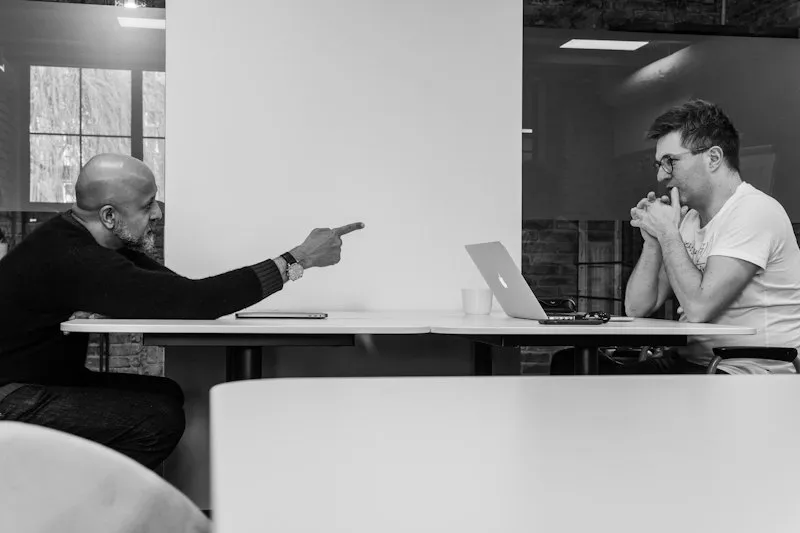
Look at whether the conflict has moved back and forth between task issues and personal attacks. Research shows that task and relationship conflict often co-occur, and when they do, the task conflict becomes more harmful. If a disagreement that started about work has turned into personal criticism, it has likely escalated into relationship conflict. You can try to notice when the conversation shifts from work content to personal traits.
Studies have found that task conflict is less detrimental when it is not highly associated with relationship conflict. If a conflict mixes both types, its negative effects increase. By tracking whether the discussion stays on the task or drifts into personal territory, you can gauge whether the conflict is primarily about the work or has become personal.
Take it further
Noticing Patterns
When you recall a recent workplace disagreement, what helped you see whether it was about the work or about something personal?
Talk it out
Talking It Over
Have you ever been in a team where a task disagreement turned into a personal conflict? What was that like?
References
Sources & evidence
4 research papers informed this article. The numbers beside each section link here, and each DOI opens the original paper.
Source 1:Individual Perceptions of Task Conflict and Relationship Conflict
Solansky, Stephanie T., Singh, Barjinder, Huang, Shengsheng (2014). Individual Perceptions of Task Conflict and Relationship Conflict. DOI 10.1111/ncmr.12027
DOI 10.1111/ncmr.12027articleSource 2:The paradox of intragroup conflict: A meta-analysis.
de Wit, Frank R. C., Greer, Lindred L., Jehn, Karen A. (2012). The paradox of intragroup conflict: A meta-analysis.. DOI 10.1037/a0024844
DOI 10.1037/a0024844articleSource 3:A Multimethod Examination of the Benefits and Detriments of Intragroup Conflict
Jehn, Karen A. (1995). A Multimethod Examination of the Benefits and Detriments of Intragroup Conflict. DOI 10.2307/2393638
DOI 10.2307/2393638articleSource 4:Conflict and Performance in Global Virtual Teams
Kankanhalli, Atreyi, Tan, Bernard C.Y., Wei, Kwok-Kee (2006). Conflict and Performance in Global Virtual Teams. DOI 10.2753/mis0742-1222230309
Next read
Keep reading
 MomentsHow do I stop disagreements at work from becoming personal?When a work disagreement starts to feel like a personal attack, see why trust matters and try one separating statement to reset the conversation.3 min read
 DecisionHow to Tell if You're Fighting About the Task or About Each OtherLearn to distinguish task conflict from relationship conflict in your team disagreements and choose a strategy based on your current capacity.4 min read
 ExplainerTask Conflict vs Relationship ConflictTask conflict involves disagreements about work ideas, while relationship conflict involves personal friction. Learn how they differ and their effects.6 min read
 How-toHow to Tell If a Team Fight Is About the Task or About UsLearn how to distinguish task conflict from relationship conflict in your team, using indicators researchers have identified.3 min read
 ExplainerTask Conflict vs. Relationship ConflictTask conflict centers on work disagreements; relationship conflict involves personal clashes. Learn their differences, effects, and resolution approaches.6 min read
 ExplainerWhat Is Relationship Conflict?Relationship conflict is interpersonal incompatibility causing friction and reduced team performance.5 min read