
Making Peace with Painful Thoughts
Learn three practices from ACT, DBT, and self-compassion that can help you relate to painful thoughts with acceptance rather than struggle.
The question
How do I make peace with painful thoughts instead of fighting them?

Overview
To make peace with painful thoughts, you can shift from fighting or avoiding them to observing them with acceptance. The practices described below-drawn from Acceptance and Commitment Therapy, Dialectical Behavior Therapy, and self-compassion frameworks-offer different ways to do this, though research has not shown that one approach works best for everyone.
Each practice involves a subtle but important change in how you relate to your inner experience. Rather than trying to eliminate or control thoughts, you can learn to notice them without being consumed by them, allowing painful content to be present while continuing to move in a direction that matters to you.
ACT Observing Self

This practice involves stepping back and watching your thoughts and feelings as if you are an observer, separate from the content of your mind. You might try saying to yourself, "I'm having the thought that I'm a bad person" instead of "I'm a bad person." One exercise imagines your thoughts as signs carried by soldiers in a parade: you watch the parade go by without jumping into it. No special equipment is needed, but it may feel unnatural at first.
Acceptance and Commitment Therapy teaches this stance as a way to abandon attempts to control or avoid thoughts and feelings. The idea is that adopting a stance of acceptance toward painful thoughts changes the psychological context, making distress feel less threatening. However, studies of this specific observation exercise have not been compared to other practices, so it's unclear how it works for different people.
DBT Mindfulness Skills

Dialectical Behavior Therapy teaches mindfulness skills that help you accept yourself, your history, and your current situation exactly as they are while still working toward change. One exercise involves imagining your mind as the sky and your thoughts as passing clouds-you notice them without holding on. Another uses the metaphor of a conveyor belt: you observe, label, and categorize thoughts and sensations as they appear. You can practice during daily activities, not only while sitting still.
DBT explicitly combines acceptance with change, encouraging you to accept reality while building a better life. Mindfulness exercises include breath awareness and labeling thoughts rather than judging them. DBT does not prescribe a fixed practice schedule; goals are set individually. This framework has been studied in clinical settings, but the effects of specific mindfulness exercises on making peace with thoughts may depend on the individual and their context.
Self-Compassion Practice
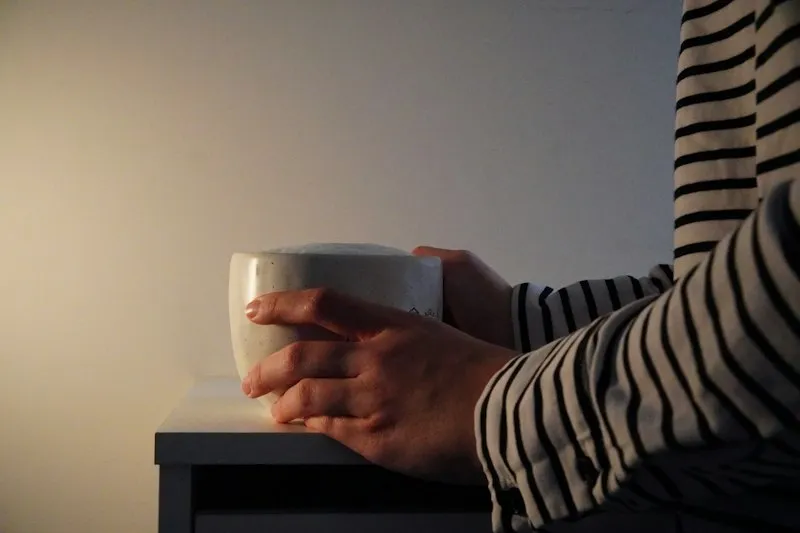
Self-compassion offers a way to hold painful thoughts with kindness rather than struggle. It involves three parts: self-kindness (being warm toward yourself), recognizing common humanity (seeing that suffering is universal), and mindfulness (holding thoughts in balanced awareness). When a painful thought arises, you might silently say something like, "This hurts, and I'm not alone in this." The aim is to approach distress with understanding, not to fix or avoid it.
Self-compassion is considered an emotional approach to coping-it requires mindful awareness of emotions so that you don't avoid them but meet them with care. Research suggests this can transform negative feelings and help you see your situation more clearly, though studies often measure self-compassion as a trait rather than testing short exercises. The practice relies on a mindful foundation, so it may not feel natural right away.
Take it further
Noticing Your Reactions
What is one painful thought you might be able to simply notice today, without needing to argue with or push it away?
Talk it out
Starting a Conversation
Have you ever tried just observing a difficult thought without reacting, and if so, what was that like?
References
Sources & evidence
4 research papers informed this article. The numbers beside each section link here, and each DOI opens the original paper.
Source 1:Mindfulness training as a clinical intervention: A conceptual and empirical review.
Ruth A. Baer (2003). Mindfulness training as a clinical intervention: A conceptual and empirical review.. DOI 10.1093/clipsy.bpg015
DOI 10.1093/clipsy.bpg015articleSource 2:Self-Compassion: An Alternative Conceptualization of a Healthy Attitude Toward Oneself
Kristin D. Neff (2003). Self-Compassion: An Alternative Conceptualization of a Healthy Attitude Toward Oneself. DOI 10.1080/15298860309032
DOI 10.1080/15298860309032articleSource 3:Mindfulness: A proposed operational definition.
Scott R. Bishop, Mark A. Lau, Shauna L. Shapiro, Linda E. Carlson, Nicole D. Anderson, James Carmody, Zindel V. Segal, Susan Abbey, Michael Speca, Drew M. Velting, Gerald M. Devins (2004). Mindfulness: A proposed operational definition.. DOI 10.1093/clipsy.bph077
DOI 10.1093/clipsy.bph077articleSource 4:Effectiveness of a meditation-based stress reduction program in the treatment of anxiety disorders
1992. Effectiveness of a meditation-based stress reduction program in the treatment of anxiety disorders. DOI 10.1176/ajp.149.7.936
DOI 10.1176/ajp.149.7.936article
Next read
Keep reading
 MomentsWhy do I eat junk food when I'm in a bad mood?When you reach for junk food in a bad mood, it's your brain seeking quick relief. Learn why it happens and how to pause before eating.2 min read
 DecisionWhy Do I Feel Stressed Just Because My Coworker Is Upset?Feeling stressed because a coworker is upset likely stems from emotional contagion. This article presents three strategies for handling this moment.4 min read
 ExplainerEmotion RegulationEmotion regulation is the ability to manage emotional responses. Learn what it involves, how it's measured, and strategies for balanced emotional health.5 min read
 How-toRecognizing Low Distress Tolerance When Stress HitsWhen stress hits, learning to notice low distress tolerance can help you pause before reaching for junk food. Simple awareness is a first step.3 min read
 ExplainerEmotion Regulation SkillsEmotion regulation skills help manage feelings constructively. Learn how they are defined, what they include, and what outcomes are linked to them.6 min read
 ExplainerHow Acceptance and Procrastination Are RelatedProcrastination is linked with lower self-compassion. Acceptance may help reduce stress from procrastination, but the relationship is nuanced.5 min read