
Why does my body sometimes feel like it's not mine?
If you've felt disconnected from your body, it's not a sign of being broken. It's a temporary glitch in how your brain builds body ownership.
Sound familiar?
You're sitting normally, yet your hand or whole body suddenly feels alien, as if it belongs to someone else.

Overview
If you have ever felt like your body doesn't quite belong to you, you are not alone. This sensation is a passing glitch in how the brain maintains body ownership - the feeling that this body is yours. It's a normal result of how your brain predicts what you should feel.
Moments like the rubber hand illusion show that body ownership is built from how multiple senses combine. When they send conflicting signals - for example, seeing a fake hand while feeling a brush on your real hand - your brain may briefly update its model, making the fake hand feel real or your own hand feel strange. This is not a disorder; it is an everyday demonstration of a plastic, predictive mind.
Why This Moment Happens
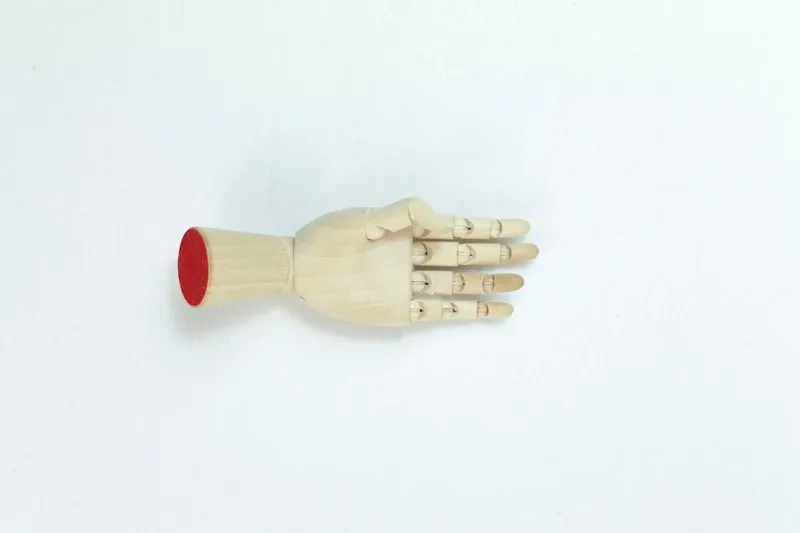
Body ownership is not a fixed property; it is an ongoing prediction constructed from multiple senses - touch, vision, and the sense of your own heartbeat. In the rubber hand illusion, a visible fake hand is stroked at the same time your real hidden hand is stroked. Your brain receives matching visual and tactile signals, so it predicts the fake hand is part of your body. When subjects see the fake hand threatened, their skin conductance response spikes, showing the illusion has taken hold.
Some people are more prone to these disconnection moments. Individuals with lower sensitivity to internal signals - such as a less accurate sense of their own heartbeat - are more easily swayed by visual or tactile cues. This means the feeling of "not mine" can arise more often when your attention is pulled outward, away from the quiet sense of your own body. It is a reflection of how your brain weighted the evidence right then, not a statement about you.
The Grounding Breath and Touch Check

When the disconnection arrives, you can gently recalibrate your brain's model in about 30 seconds. Bring one hand to your opposite forearm and press lightly. Breathe in slowly for four counts, noticing the pressure of your fingers on your skin. On the exhale, read the same area with your thumb, deliberately feeling the fabric of your sleeve or the warmth of your own skin. The goal is to give your brain a synchronous tactile and interoceptive signal: you are touching yourself, and you feel it.
This simple action works by overriding the multisensory conflict with a coherent, self-generated stimulus. The rubber hand illusion fades when the stimulation stops and you reconnect with your body's own signals. By creating a moment of calm, attended touch, you help your brain update its prior: this body is yours again. It is not a complete fix, but it is a reliable way to break the spell of disconnection.
Where are you
What feels closest to your situation right now?
Pick the situation that feels closest and bring it into a private reflection in Mneno.
Not sure? Start here:Help me understand this situation and choose one constructive next step.
- It just happened once and I felt confused.Help me understand this momentary glitch and how I can ground myself if it returns.
- This happens sometimes, especially when I am stressed or tired.Help me explore why it occurs more often during stress and find a simple coping step.
- I am mainly curious about how the brain makes a body feel like mine.Help me learn more about body ownership and why the feeling can shift.
References
Sources & evidence
2 research papers informed this article. The numbers beside each section link here, and each DOI opens the original paper.
Source 1:Interoceptive inference, emotion, and the embodied self
Seth, Anil K. (2013). Interoceptive inference, emotion, and the embodied self. DOI 10.1016/j.tics.2013.09.007
Source 2:Projecting sensations to external objects: evidence from skin conductance response
Armel, K. Carrie, Ramachandran, V. S. (2003). Projecting sensations to external objects: evidence from skin conductance response. DOI 10.1098/rspb.2003.2364
article
Keep reading
 DecisionWhy Does My Body Sometimes Feel Like It Doesn't Belong to Me?Explore why your body can feel alien and how to choose a response that fits your current capacity.3 min read
 TechniquesWhy Do I Sometimes Feel Like My Body Isn't Mine?Learn about experiences where your body feels unfamiliar with practices like the rubber hand illusion, self-objectification, and interoceptive sensitivity.3 min read
 ExplainerThe Rubber Hand IllusionLearn what the rubber hand illusion is, how it works, and what it reveals about body ownership, sensory perception, and the plasticity of body image.5 min read
 ExplainerWhat Is the ACE Somatic Health Gradient?The ACE somatic health gradient shows that as adverse childhood experience scores rise, the odds of severe obesity and multiple somatic symptoms increase in a6 min read