
The rubber hand illusion is a perceptual phenomenon where synchronous stroking of a visible fake hand and your own hidden hand makes you feel as if the fake hand belongs to your body. Within minutes, this simple multisensory trick can override a lifetime of experience and even change your sense of body ownership.
In a classic experiment, participants rated the fake hand feeling like their own as 7.6 out of 10, with significantly higher ratings than in control conditions. The illusion shows that body image is a transitory internal construct that can be profoundly modified by just a few minutes of appropriate sensory stimulation.
What Happens During the Illusion
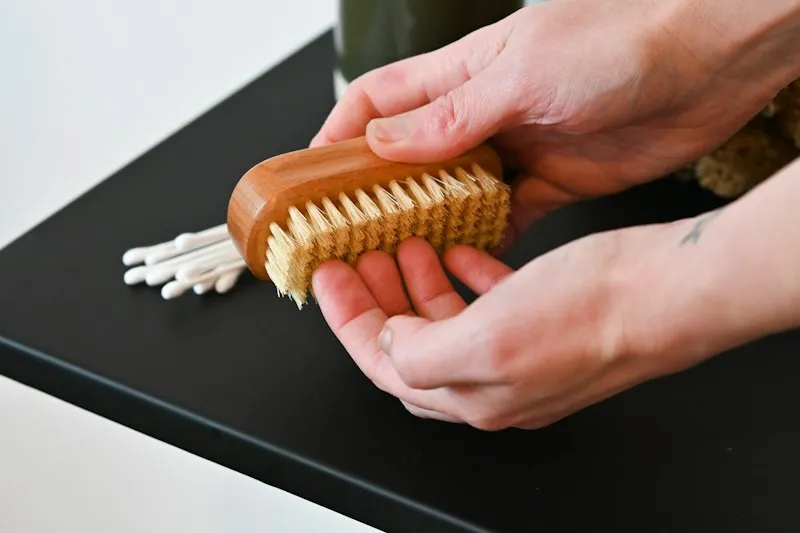
In a typical rubber hand illusion setup, you sit with one arm hidden from view, while a realistic rubber hand is placed in front of you. The experimenter strokes both your real hand and the rubber hand simultaneously with a brush. When the strokes are synchronous, your brain integrates the visual and tactile signals, creating a powerful sense that the rubber hand is your own.
The subjective experience can be striking. Many participants report vivid reactions such as exclaiming 'wow', 'that was bizarre', or 'oh my God'. Some find the illusion so convincing that they wonder why their hand is so white or how they bruised it (due to an ink smudge). During pilot work, participants often behaved as if anticipating pain when the rubber finger was bent back, laughing nervously and widely opening their eyes.
Take it further
Explore Together
Would you be curious to try the rubber hand illusion and see how your own brain responds?
Reflect in Mneno
How the Illusion Is Measured
Researchers measure the rubber hand illusion using both subjective reports and objective physiological responses. Participants rate how much the fake hand feels like their own, typically on a scale from 0 to 10. In one study, the average rating was 7.6, significantly higher than in control conditions where stroking was asynchronous.
A key objective measure is skin conductance response (SCR). When the fake hand is threatened-for example, by a hammer or a needle-participants show elevated SCR, indicating a physiological stress response. This suggests they have projected sensation and threat onto the fake hand, treating it as part of their own body. The combination of self-report and SCR provides converging evidence that the illusion genuinely alters the experience of body ownership.
Who Is Most Susceptible

Not everyone experiences the rubber hand illusion with the same intensity. Susceptibility is linked to interoceptive sensitivity-your ability to perceive internal body signals such as your heartbeat. People with lower interoceptive sensitivity are more susceptible to the illusion.
This connection suggests that if your brain gives less weight to internal bodily signals, it relies more on external sensory cues (like vision and touch) to determine body ownership. As a result, body ownership becomes more malleable. This finding provides a bridge to understanding disorders of body image and ownership, such as anorexia nervosa or depersonalization, where disrupted interoceptive inference may play a role.
What the Illusion Reveals About Body Image

The rubber hand illusion demonstrates that body image is not fixed but is a dynamic, multisensory construct. Even a lifetime of experience with your own body can be overridden by a few minutes of conflicting sensory input. This plasticity is a fundamental property of how the brain constructs the sense of self.
The illusion also highlights the role of prediction errors. When your brain expects to feel touch on your hidden hand but sees touch on the rubber hand, the synchronous stroking resolves the conflict by 'remapping' the feeling onto the fake hand. This illustrates how multisensory conflicts induce prediction errors that update self-related priors, reshaping the experience of body ownership.
FAQ
Common questions
Each answer is linked to its research.
Can the rubber hand illusion cause pain responses?
Yes, when the fake hand is threatened-such as when its finger is bent back or a hammer is swung toward it-participants often show physiological and behavioral signs of anticipating pain. In one study, participants exhibited elevated skin conductance responses (SCRs), indicating a stress reaction. During pilot work, participants laughed nervously and opened their eyes widely when the rubber finger was bent back, as if expecting pain. These responses suggest that the illusion leads the brain to treat the fake hand as part of the body, including projecting threat and potential pain onto it.
SourcesS2S3All sources
How long does it take for the rubber hand illusion to work?
The illusion typically develops within a few minutes of synchronous stroking. In experimental settings, stroking durations of around 2 to 3 minutes are common. The effect can be so rapid that it overrides a lifetime of experience with your own body, as participants report a strong sense of ownership within that short timeframe. The speed of the illusion underscores the brain's rapid recalibration of body ownership based on current sensory input.
SourcesS1S3All sources
What happens if the stroking is not synchronous?
When the stroking of the rubber hand and the participant's real hand is asynchronous, the illusion does not occur. In control conditions with asynchronous stroking, participants report significantly lower ratings of the fake hand feeling like their own. The synchronous timing is crucial because it matches the visual and tactile signals, allowing the brain to integrate them into a coherent experience. Without synchrony, the brain detects a mismatch and does not update body ownership to include the fake hand.
SourcesS1S3All sources
Next read
Keep reading
Nearby guides picked by the editors of this article.
 MomentsWhy does my body sometimes feel like it's not mine?If you've felt disconnected from your body, it's not a sign of being broken. It's a temporary glitch in how your brain builds body ownership.3 min read
 DecisionWhy Does My Body Sometimes Feel Like It Doesn't Belong to Me?Explore why your body can feel alien and how to choose a response that fits your current capacity.3 min read
 TechniquesWhy Do I Sometimes Feel Like My Body Isn't Mine?Learn about experiences where your body feels unfamiliar with practices like the rubber hand illusion, self-objectification, and interoceptive sensitivity.3 min read
 ExplainerWhat Is the ACE Somatic Health Gradient?The ACE somatic health gradient shows that as adverse childhood experience scores rise, the odds of severe obesity and multiple somatic symptoms increase in a6 min read
References
Sources & evidence
4 research papers informed this article. The numbers beside each section link here, and each DOI opens the original paper.
Source 1:Projecting sensations to external objects: evidence from skin conductance response
Armel, K. Carrie, Ramachandran, V. S. (2003). Projecting sensations to external objects: evidence from skin conductance response. DOI 10.1098/rspb.2003.2364
articleSource 2:Interoceptive inference, emotion, and the embodied self
Seth, Anil K. (2013). Interoceptive inference, emotion, and the embodied self. DOI 10.1016/j.tics.2013.09.007
Source 3:The Psychology of Physical Symptoms
Pennebaker, James W. (1982). The Psychology of Physical Symptoms. DOI 10.1007/978-1-4613-8196-9
Source 4:That swimsuit becomes you: Sex differences in self-objectification, restrained eating, and math performance.
Fredrickson, Barbara L., Roberts, Tomi-Ann, Noll, Stephanie M., Quinn, Diane M., et., al. (1998). That swimsuit becomes you: Sex differences in self-objectification, restrained eating, and math performance.. DOI 10.1037/0022-3514.75.1.269