
Why You Might Doubt Your Ability to Succeed in Your Studies
Doubt in your studies may reflect task-specific confidence gaps, not a fixed limit. Compare practical ways to examine and build academic self-efficacy.
The question
Why do I doubt my ability to succeed in my studies?

Overview
Doubt about your ability to succeed in your studies may be less about a fixed limit and more about how closely your confidence matches the specific task in front of you. Academic self-efficacy is your judgment about your ability to carry out and achieve learning goals, and it is domain-specific rather than a general verdict on your worth or intelligence.
The excerpts describe several practical ways to work with this kind of doubt: matching your confidence to the exact task, checking your confidence in managing your learning environment, deliberately building task-specific confidence, and using a short inventory to make your self-judgments more concrete. The evidence does not establish which of these fits everyone, and the findings are largely correlational rather than proof that any one practice will change your outcomes.
Match Confidence to the Task
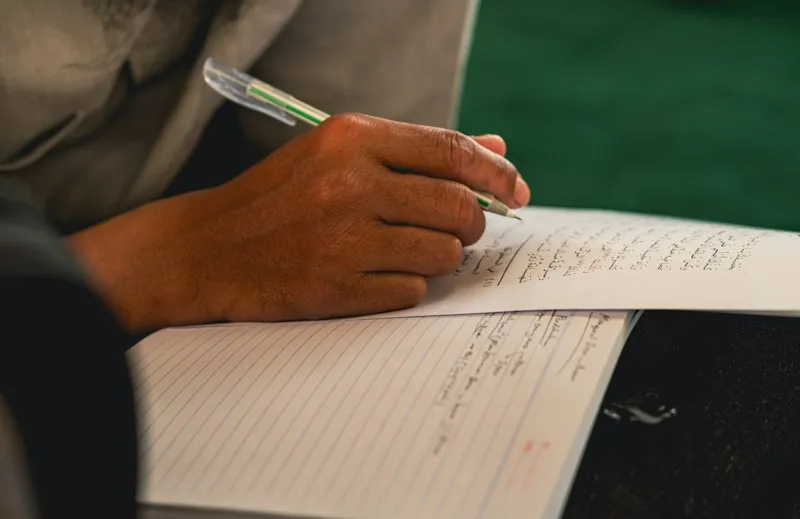
You can try naming the specific study task you are judging, such as writing one section of an essay or completing a problem set, and then asking yourself how confident you are in that exact task rather than in your general ability as a student. This requires only a few minutes and a pen or notes app, and you can do it before you begin.
The excerpts describe academic self-efficacy as predicting performance best when the confidence measure closely matches the performance domain. When the match is weak, self-efficacy has less predictive power, which may help explain why the relationship between academic self-efficacy and procrastination was significant but modest in one study. That study looked at timely task completion, and the authors note the measure did not closely match that criterion. This is a limit on prediction, not a pr
Check Self-Regulation Confidence

You can try rating your confidence in managing your learning environment, such as keeping distractions away, planning when to study, and sticking to a schedule. Write down two or three specific management tasks and rate how confident you feel about each one. This takes only a few minutes and can be done alone.
The excerpts describe higher confidence in managing one's learning environment as associated with less procrastination. Students who believed they could regulate their learning tended to delay tasks less than peers with lower self-efficacy for self-regulation. One study also found that academic self-control fully mediated the relationship between academic self-efficacy and procrastination, meaning confidence did not directly predict delay once self-control was accounted for. These are associatio
Build Task-Specific Confidence
You can try choosing one small study task you feel uncertain about and breaking it into a first step you can complete today, then noting your confidence before and after that step. This requires a short block of time and a way to record your judgments. It is about gathering your own evidence rather than forcing yourself to feel confident.
The excerpts describe higher self-efficacy as associated with stronger task initiation, greater self-regulatory effort, and better academic performance, while low confidence can undermine effective action in challenging situations. Most participants in one study viewed high academic self-efficacy as a buffer against harmful procrastination. These are associations and participant views, not demonstrated effects of a standalone confidence-building exercise, so treat any change in your own confiden
Use a Self-Efficacy Inventory

You can try using a short inventory to make your self-judgments more concrete. One described measure, the Educational Psychology Self-Efficacy Inventory, asks you to rate eight statements from 1, meaning nothing like me, to 5, meaning a great deal like me. Sample items ask whether you can learn educational psychology and whether you have good skills and strategies for doing so.
The excerpts describe this inventory as an eight-item Likert scale measuring confidence about learning educational psychology specifically. It is a measurement tool, not a training program, and the evidence does not show that completing it improves confidence or performance. Its value in this context is that it illustrates how specific confidence questions can be phrased, and it may help you notice which parts of your study confidence feel shaky.
Take it further
Notice Your Doubt
Which specific study task brings up the most doubt for you right now, and what might help you judge that task more precisely?
Talk it out
Talk About Confidence
What kind of study task feels hardest to judge your confidence in, and who might help you look at it more closely?
References
Sources & evidence
4 research papers informed this article. The numbers beside each section link here, and each DOI opens the original paper.
Source 1:Academic procrastination of undergraduates: Low self-efficacy to self-regulate predicts higher levels of procrastination
Klassen, Robert M., Krawchuk, Lindsey L., Rajani, Sukaina (2008). Academic procrastination of undergraduates: Low self-efficacy to self-regulate predicts higher levels of procrastination. DOI 10.1016/j.cedpsych.2007.07.001
Source 2:Academic Self-Efficacy and Postgraduate Procrastination: A Moderated Mediation Model
Liu, Guoqing, Cheng, Gang, Hu, Juan, Pan, Yun, et., al. (2020). Academic Self-Efficacy and Postgraduate Procrastination: A Moderated Mediation Model. DOI 10.3389/fpsyg.2020.01752
DOI 10.3389/fpsyg.2020.01752articleSource 3:Examining ‘active’ procrastination from a self-regulated learning perspective
Cao, Li (2012). Examining ‘active’ procrastination from a self-regulated learning perspective. DOI 10.1080/01443410.2012.663722
Source 4:Procrastination and Motivation of Undergraduates with Learning Disabilities: A Mixed‐Methods Inquiry
Klassen, Robert M., Krawchuk, Lindsey L., Lynch, Shane L., Rajani, Sukaina (2008). Procrastination and Motivation of Undergraduates with Learning Disabilities: A Mixed‐Methods Inquiry. DOI 10.1111/j.1540-5826.2008.00271.x